Between-Pad-Groove (BPG) Journal Bearing

Superior lubrication control and efficiency for high-speed turbomachinery.
Engineered for Turbomachinery Efficiency
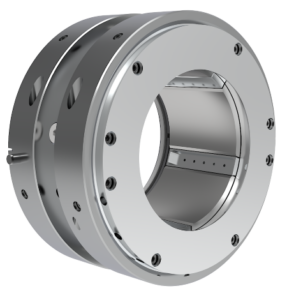
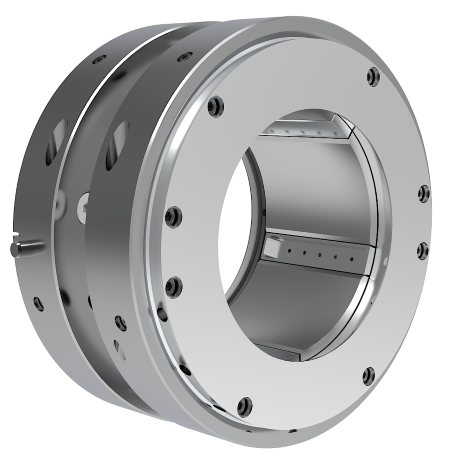
Kingsbury’s Between-Pad-Groove (BPG) Journal Bearing delivers exceptional performance in high-speed rotating machinery where stability, oil flow control, and reduced power loss are critical. The BPG’s patented design incorporates a directed lubrication system with a distinctive oil groove placed between each pad, creating precise oil distribution that minimize heat generation in the oil film. BPG bearings offer the flexibility to minimize oil flow where efficiency is a priority, as well as provide high capacity oil flow for demanding high load and high speed applications beyond 110 m/s sliding velocity.
How They Work
Unlike flooded journal bearings, the BPG design eliminates end plates and allows oil to pass freely through the bearing. This streamlined flow path reduces turbulence, lowers oil temperatures, and improves film stability under demanding load and speed conditions. The result is a bearing system designed for extreme operating conditions.
Performance Highlights
Field performance and test data have demonstrated that BPG bearings can:
-
Reduce total oil flow by up to 50% compared to flooded designs
-
Lower operating temperatures by 8–28°C, depending on system conditions
-
Improve load-carrying capacity by 10–20% within the same housing footprint
-
Decrease overall power loss through optimized lubrication
- Maximum oil flow for extreme applications
Operational Advantages
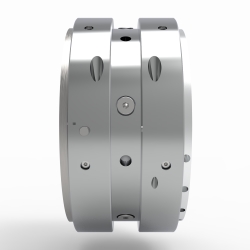
The BPG combines simple assembly with superior hydrodynamic stability. With only three main components, an aligning ring, bearing pads, and oil-feed bars, installation and maintenance are straightforward. This simplicity contributes to shorter downtime, longer service life, and predictable performance in mission-critical equipment. End plates and oil deflectors can be easily incorporated into the design as needed by the application.
Why Choose Kingsbury?
Trusted Engineering Leadership
For over a century, Kingsbury has set the standard in hydrodynamic bearing innovation. The BPG design continues that legacy by combining proven technology with modern lubrication efficiency. Every bearing is manufactured to ISO quality standards and inspected for precise dimensional control, ensuring performance you can trust in the most demanding turbomachinery applications.
Comprehensive Support
From concept to commissioning, Kingsbury engineers provide full technical support—including design consultation, thermal and dynamic analysis, and field inspection services. Whether you’re specifying a new installation or retrofitting an existing system, our team will help optimize bearing performance and system reliability.
Between-Pad-Groove (BPG) Journal Bearing
BPG Journal Bearings
Kingsbury BPG journal bearings are tilting pad journal bearings designed to provide stable hydrodynamic performance across a wide range of operating conditions. By allowing each pad to pivot independently, BPG bearings maintain a consistent oil film, reduce vibration, and improve reliability in demanding rotating equipment.
This design makes BPG journal bearings well suited for applications where shaft stability, load capacity, and predictable dynamic behavior are critical.
General Description
BPG journal bearings use multiple pivoted pads, usually four or five, arranged circumferentially around the shaft. Each pad forms its own hydrodynamic oil film, allowing the bearing to adapt to changes in load, speed, and operating conditions.
The tilting pad configuration provides inherent stability and minimizes the risk of oil whirl and oil whip, which can occur in fixed profile journal bearings operating at higher speeds.
Key features that distinguish BPG journal bearings include:
-
Individually pivoted pads that promote stable oil film formation
-
Can be designed for bi-directional shaft rotation
-
Improved rotor stability compared to fixed profile journal bearings
-
Reduced sensitivity to load variation and operating transients
-
Design flexibility to accommodate a wide range of speeds and loads
These features allow BPG bearings to operate reliably in applications where dynamic performance is a primary concern.
Bearing Design and Operation
BPG journal bearings support radial loads through a series of four or five pads that pivot about their supports to form hydrodynamic oil films. As the shaft rotates, each pad adjusts its position to maintain an optimal film thickness.
Pads
BPG pads are designed to provide consistent hydrodynamic performance and long-term durability. Pad geometry, pivot design, and material selection are optimized to promote stable operation across the operating range.
Standard pad construction includes steel bodies with babbitted surfaces. Alternative materials and configurations can be specified for elevated temperatures, unusual operating conditions, or specific lubrication requirements.
Pivot Design
The pivot arrangement allows each pad to tilt freely in response to load and shaft motion. This self-adjusting behavior helps maintain proper alignment between the shaft and bearing surface, improving load distribution and reducing localized stress.
Lubrication
BPG journal bearings are compatible with a range of lubrication volume depending on application requirements. Oil is supplied to ensure adequate film formation and heat removal while maintaining stable bearing operation.
Lubrication system design, oil flow rates, and supply pressures should be selected based on operating speed, load, and thermal conditions.
Performance Compared to Fixed Profile Journal Bearings
Compared to fixed profile journal bearings, BPG designs offer improved dynamic stability and reduced susceptibility to vibration-related issues. The tilting pad configuration minimizes cross-coupling forces that can destabilize the rotor at higher speeds.
These performance advantages make BPG journal bearings a preferred choice for high-speed machinery and applications with stringent stability requirements.
Applications
BPG journal bearings are commonly used in turbines, gearboxes, compressors, pumps, and other rotating equipment where stability and reliability are critical. They are suitable for both new installations and upgrades where improved dynamic performance is required.
Applying BPG Journal Bearing Technology
BPG journal bearings provide a robust solution for applications that demand stable rotor behavior, consistent load support, and long service life. Their tilting pad design offers predictable performance across a wide operating range.
Kingsbury’s engineering team can assist with bearing selection, lubrication recommendations, and application review to determine whether a BPG journal bearing is the appropriate solution for your operating conditions.
Industries and Systems Served
Kingsbury LEG thrust bearings operate in environments where efficiency, oil control, and thermal stability are critical. They are installed worldwide in systems such as:
- Gas and steam turbines used in power generation and industrial processes.
- Compressors and pumps supporting oil and gas operations
- Marine propulsion systems across commercial and military fleets
- Industrial gearboxes and turboexpanders
- High-speed test stands and rotating machinery laboratories
Their versatility and documented performance have made LEG bearings a preferred choice for OEMs and retrofit specialists across global rotating equipment markets.
Retrofit or Upgrade Scenarios
LEG bearings are an effective upgrade for older flooded-lubricated systems that are running close to their thermal limits. The directed lubrication and leading-edge groove geometry help reduce oil flow requirements and distribute load more effectively, which allows many retrofits to be completed without major changes to the thrust bearing assembly.
A well-planned LEG retrofit often delivers clear improvements:
• Lower operating temperatures
• Reduced demand on the lube system
• Higher overall efficiency and improved uptime
Kingsbury’s engineering and field service teams support every retrofit with proper fit checks, alignment guidance, and commissioning support to ensure the bearing performs as intended over the long term.
Retrofit or Upgrade Scenarios
LEG bearings are an effective upgrade for older flooded-lubricated systems that are running close to their thermal limits. The directed lubrication and leading-edge groove geometry help reduce oil flow requirements and distribute load more effectively, which allows many retrofits to be completed without major changes to the thrust bearing assembly.
A well-planned LEG retrofit often delivers clear improvements:
• Lower operating temperatures
• Reduced demand on the lube system
• Higher overall efficiency and improved uptime
Kingsbury’s engineering and field service teams support every retrofit with proper fit checks, alignment guidance, and commissioning support to ensure the bearing performs as intended over the long term.
 A detailed engineering guide covering LEG Bearing design principles, lubrication strategies, sizing considerations, and performance characteristics for high‑load thrust and journal bearing applications.Read more