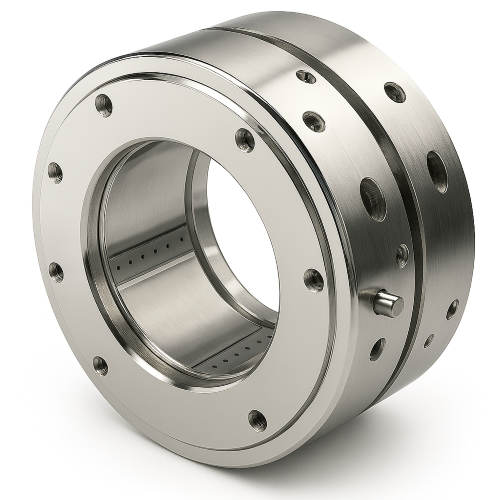
Journal Bearing, Model PJ, Flooded Lubrication Type

Kingsbury’s Model PJ flooded lubrication journal bearing employs a pivoted shoe design to maintain hydrodynamic stability and operating margin under real-world industrial conditions.
Flooded Tilting Pad Journal Bearings for Moderate-Speed Rotating Equipment
Kingsbury flooded tilting pad journal bearings are designed to provide stable shaft support and predictable thermal behavior in moderate-speed rotating machinery. The Model PJ configuration uses a fully flooded oil cavity to maintain continuous hydrodynamic film formation, offering operational tolerance during oil system disturbances while preserving rotordynamic stability.
Performance Highlights
The pivoted shoe design allows each pad to align independently with the rotating shaft, maintaining a stable hydrodynamic film across a range of loads and operating conditions. This inherent adaptability eliminates oil film instability commonly observed in fixed-geometry journal bearings under light load conditions.
Flooded lubrication provides additional operating margin during short-duration oil supply disturbances. In field environments, this margin can be meaningful during filter changeovers, pump transitions, or temporary system upsets.
At moderate surface speeds, flooded bearings demonstrate consistent temperature profiles and stable shaft positioning when oil cleanliness and flow are maintained. However, as surface speeds approach the upper recommended limit of approximately 70 m/s, increased oil churning and recirculation of heated oil can elevate operating temperatures and power loss.
For applications approaching these limits, inspection trends often show rising pad temperatures and reduced thermal margin, signaling the need to reassess lubrication strategy rather than bearing geometry.
Technical Options
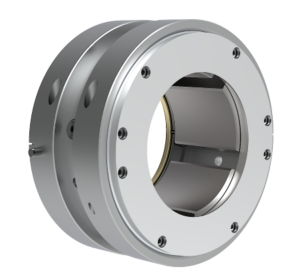
Model PJ flooded journal bearings are available in both inch and metric configurations with standard length-to-diameter ratios of 0.4, 0.7, and 1.0, allowing designers to balance load capacity, stiffness, and axial space constraints.
Typical shaft diameters range from approximately 50 mm to 300 mm, with larger sizes available for custom applications. End shields or floating rings are used to maintain a flooded internal cavity and to regulate oil residence time within the bearing.
Oil flow is controlled through annulus orifices and discharge paths rather than direct pad injection. This approach simplifies oil delivery but increases total flow and churning losses at higher speeds.
Instrumentation options include pad temperature measurement using thermocouples or RTDs, as well as proximity probes for shaft position monitoring. In practice, temperature trends are often the earliest indicator of changing operating conditions, oil degradation, or load redistribution.
While flooded lubrication is intentionally forgiving, it is not immune to thermal constraints. Elevated temperatures at higher speeds should be treated as an operating signal, not a nuisance, and may justify transitioning to directed lubrication designs when margins narrow.

Why Choose Kingsbury?
Kingsbury has been designing and manufacturing fluid film bearings for critical rotating equipment since 1912. Our flooded tilting pad journal bearings reflect decades of field observation, test validation, and direct feedback from operating plants.
What distinguishes Kingsbury is not just the bearing geometry, but the application judgment behind it. We regularly evaluate whether a flooded design remains appropriate as machines age, loads change, or operating envelopes expand beyond original design intent.
Our engineers support bearing selection, inspection interpretation, and retrofit decisions with the same focus, ensuring the bearing continues to serve the machine rather than becoming its limiting factor.
Journal Bearing, Model PJ, Flooded Lubrication Type
Kingsbury Manufacturing Precision Makes the Difference
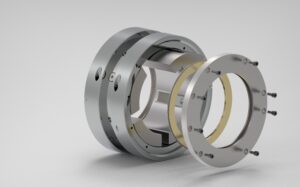
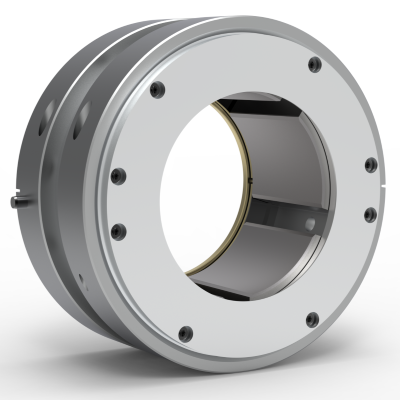
Each standard pivoted shoe journal bearing consists of five journal shoes supported in a precisely machined aligning ring. The shoes are held axially and circumferentially by shoe retaining plates.
The aligning ring, manufactured from heat treated 4100 class alloy steel, is axially split to allow easy assembly of the bearing around the shaft. Both halves are doweled for positive realignment and secured with socket head cap screws, while a hardened steel dowel on the cylindrical outside diameter prevents rotation of the bearing assembly in the housing.
An oil distribution annulus is machined into the outside of the aligning ring, and feed holes direct cool oil from the distribution annulus to the spaces between adjacent journal shoes. Custom designed aligning rings with flanges or adjustment pads to suit special requirements can be provided on a special-order basis.
Each journal shoe is manufactured from heat treated 4100-class alloy steel, high-tin babbitt, per Federal Spec QQ·T·390 Grade 2 (ASTM B·23 Gr 2), is centrifugally cast, metallurgically bonded, then precisely machined to create the bearing surface. Proprietary manufacturing processes provide a uniform babbitt thickness across each journal shoe, while tight design tolerances permit interchangeability of shoes, both within a single bearing and between different bearings of the same size. (Each shoe is etched with its actual dimensions.)
The back of each journal shoe is contoured in two directions. This double radius design allows each shoe to adjust itself to the hydrodynamic forces generated by the rotating shaft, even under conditions of axial misalignment. The combination of hardened alloy steel and moderate Hertzian stresses allows the standard Kingsbury pivoted shoe journal bearing to be used in high shock load applications.
The shoe retaining plates are manufactured from tempered aluminum plate. They are axially split and precision bored to regulate oil discharge from the bearing assembly. Locating pins at the ends of each journal shoe match corresponding holes in the retaining plates to provide accurate circumferential positioning, and to retain shoes when the bearing assembly is split for installation or inspection. The standard retaining plates can be replaced to provide special seal provisions or thrust faces. See Optional Features.
Clearance and Preload
Bearing clearance and preload are defined by relations between the shaft. shoe and bearing radii (see Fig. 5-1). In Kingsbury’s pivoted shoe journal bearings, the babbitted shoes are precisely machined to curvature Rp. Installation in the aligning ring moves the shoes radially inward to assembled radius Rb. The difference between radius R and shaft radius Rs is the bearing’s assembled radial clearance Cb. The assembled clearance allows space for thermal expansion, shoe tilt, and oil films. It also affects the quantity of oil flowing through the film, which removes heat generated by shear.
The inward relocation of the shoes from concentric positions preloads the bearing. The mathematical expression for preload defines a relationship between the surface curvatures and the assembled clearance. Kingsbury’s standard pivoted shoe journal bearings are manufactured to provide a positive preload. This increases bearing stiffness by reducing the assembled clearance, Cb. The positive preload profile provides a larger clearance at the leading edge of the shoe, protecting against failure due to oil starvation. This assures that a converging oil wedge is always present to develop hydrodynamic forces.
Both the assembled clearance and the preload affect the operating characteristics of the bearing, such as power loss, oil and shoe temperatures, film thickness, dynamic stiffness, and damping coefficients. This catalog provides data for bearing selection based on standard values. Since the bearings are part of the machine’s dynamic system, assembled clearance and preload can be tailored to suit your specific application.
Please do not hesitate to contact our engineers for additional information.
Installation Configurations
LEG journal bearings are available with several mounting configurations to accommodate different housing designs and installation requirements. The appropriate configuration is selected based on how the bearing is located axially and circumferentially within the housing.
Pin Located
This is the most commonly used mounting configuration. A hardened steel dowel protrudes from the aligning ring and engages a hole or slot in the bearing housing. This dowel locates the bearing both axially and circumferentially, providing secure positioning during operation.
Flange Located
In this configuration, a hardened steel dowel prevents rotation of the bearing within the housing, while the shoe retaining plates extend beyond the aligning ring to locate the bearing axially. This approach is often used where axial positioning is controlled by the housing geometry rather than a pin slot.
Bolted Flange Located
This configuration is typically used when the bearing housing is not split. One of the shoe retaining plates is extended to locate the bearing axially, and mounting holes in the flange allow the bearing to be bolted directly to the housing. This provides positive axial retention and simplifies installation in enclosed housings.
Load Orientation Options
Standard five-shoe journal bearings can be oriented in different positions depending on the application and housing configuration. Orientation is determined by the location of the housing pin slot or bolt pattern.
When the load is shared between two shoes, the bearing can support higher radial loads, though this results in a greater static shaft drop. When the load is supported primarily by a single shoe, static shaft drop is minimized and vertical stiffness is increased. The appropriate orientation is selected based on load magnitude, stiffness requirements, and machine dynamics.
Quality and Manufacturing Standards
Kingsbury maintains rigorous quality standards, particularly in the manufacture of close-tolerance bearing components. Manufacturing processes, inspection methods, and calibration procedures are designed to ensure consistent quality and repeatability across all bearing types.
Advanced coordinate measurement equipment and precision machining processes support the production of bearings that meet demanding industrial, energy, and infrastructure requirements.
Lubrication Considerations
LEG journal bearings are designed to operate with clean, properly supplied lubricating oil. While a range of lubricant viscosities may be used, bearing performance, load capacity, and operating temperatures are influenced by oil type and supply conditions.
Oil supply pressure and flow should be selected to ensure adequate film formation and heat removal. Proper filtration is critical, as bearing life is strongly dependent on oil cleanliness. Kingsbury can provide guidance on lubrication system design, oil selection, and filtration recommendations based on operating conditions.
Field Service and Technical Support
Kingsbury field service engineers are available to support installation, commissioning, troubleshooting, and performance evaluation of journal bearings in service. Field support includes assistance with bearing setup, alignment verification, and evaluation of rotor dynamic behavior.
Field service teams are supported by Kingsbury’s internal engineering, manufacturing, and repair groups to ensure consistent technical guidance throughout the bearing lifecycle.
Installation and Operating Guidance
Installation and operating instructions are available to support proper bearing setup and long-term operation. Bearing clearance measurement, preload considerations, and alignment practices can vary based on configuration, number of shoes, and application requirements.
Kingsbury can provide application-specific guidance to assist OEMs and end users with installation and verification procedures.
Spare Parts and Lifecycle Support
To minimize unplanned downtime, it is recommended that critical spare components be maintained for installed bearings. Common spares may include replacement shoes and sealing components where applicable.
Kingsbury maintains inventory of replacement parts and provides repair, refurbishment, and upgrade services to support long-term bearing operation.
Manufacturing Capabilities and Special Designs
Kingsbury manufactures journal and thrust bearings across a wide range of sizes and configurations, supporting both standard products and application-specific designs. Advanced manufacturing systems and experienced personnel enable consistent quality and reliable delivery.
Custom bearing designs and retrofit solutions are available for upgraded machines or new installations. These designs combine practical packaging with performance-driven engineering tailored to specific operating requirements.
Optional Features and Enhancements
Kingsbury journal bearings can be configured with a range of optional features to address specific operating requirements, monitoring needs, and space constraints.
Floating Seals
Floating seal rings are recommended when oil flow along the shaft must be controlled. Seal rings are installed in the shoe retaining plates to limit oil migration while allowing normal bearing operation.
Bearing Instrumentation
Journal bearing shoes can be instrumented with thermocouples or RTDs to monitor operating temperatures. Sensors may be located at the shoe center or trailing edge, depending on the application and monitoring objectives. Instrumentation type and location should be specified during the design phase.
Proximity Probes
Customer-supplied proximity probes can be mounted radially on specially designed shoe retaining plates. Probes are typically installed 90 degrees apart to monitor shaft position, vibration, or orbital motion during operation.
High Pressure Lift
For applications requiring improved start-up performance or operation at very low speeds, shoes can be modified for high-pressure oil injection. This feature establishes an oil film prior to rotation, reducing wear during start-up. High-pressure lift systems can also be supplied when required.
Thrust Capability Options
Thrust capability can be incorporated into pivoted shoe journal bearings through modifications to the shoe retaining plates or by adding thrust elements.
Flat Land Thrust Face
A babbitted thrust face with a flat land can be integrated into one or both shoe retaining plates to provide moderate axial load capacity.
Taper Land Thrust Face
A taper land thrust face is available for applications requiring higher axial load capacity. This design provides increased load handling while maintaining compact packaging.
Integrated Thrust Shoes
For higher thrust requirements, thrust shoes can be mounted on one or both ends of the journal bearing assembly. This configuration allows the use of tilting or pivoted-shoe thrust bearings integrated with the journal bearing design.
Because thrust requirements vary widely by application, thrust-capable journal bearings are typically engineered in consultation with Kingsbury.
Design Customization
While standard journal bearing configurations address many applications, Kingsbury offers custom designs for specialized operating conditions. Engineering support is available during early design stages to ensure the bearing configuration is matched to load, speed, space, and lubrication requirements.
Bearing Size and Proportions
Journal bearings can be designed with a range of diameter and length ratios to accommodate envelope constraints, load requirements, and rotor dynamics. Custom proportions are available for both small and large shaft diameters.
Shoe Backing Materials
Standard shoe backing material is heat-treated alloy steel. For applications where operating temperatures are elevated, alternative materials such as chrome-copper may be specified. Chrome-copper provides improved thermal conductivity, helping to reduce babbitt temperatures in high-speed or high-load applications. Additional materials are available for high ambient or high inlet oil temperature conditions.
Lubrication Control Options
Standard oil flow is typically controlled by an orifice in the bearing supply line. Where required, individual orifices can be incorporated directly into the bearing feed passages to fine-tune oil distribution and flow control.
Leading Edge Groove (LEG) Technology
Pivoted shoe journal bearings are available with Kingsbury’s Leading Edge Groove (LEG) technology. LEG designs reduce oil flow requirements while improving thermal performance and operating efficiency by delivering cool oil directly into the hydrodynamic film.
Engineering Support
Journal bearings with optional features or integrated thrust capability are engineered to meet specific application requirements. Kingsbury’s engineering team works closely with OEMs and end users to confirm bearing configuration, lubrication strategy, and performance expectations before finalizing the design.
Bearing Parameters Affecting System Dynamics
Standard journal bearing configurations are designed to provide reliable performance across a wide range of applications. Because bearing behavior is closely tied to overall system dynamics, some applications benefit from variations to standard designs. Several bearing parameters can be adjusted to optimize stiffness, damping, and dynamic response.
Bearing stiffness and damping coefficients can be provided to support system-level analysis. Kingsbury engineering support is available to assist with selection and optimization based on specific operating conditions.
Number of Shoes
Five-shoe journal bearings are commonly used because they perform well across a broad range of applications. In some cases, four-shoe configurations are selected to meet specific dynamic requirements.
The number of shoes may also be influenced by shoe proportions. Bearings with shorter axial lengths may require more than five shoes to achieve desired performance. For specialized applications, bearings with a higher number of shoes have been supplied.
Bearing Orientation
Bearing orientation should be considered for machines with varying load magnitude or direction. Orientation, in combination with the number of shoes, can be selected to optimize load handling and dynamic performance for the operating conditions.
Clearance and Preload
Bearing clearance and preload have a direct influence on stiffness, damping, and overall dynamic behavior. A standard average preload value is commonly used, but non-standard clearance or preload values can be specified to refine bearing performance and system response.
B/A Ratio
The ratio of axial length to diameter is another method for adjusting bearing dynamic characteristics. By modifying bearing diameter, axial length, or both, stiffness and damping can be tailored to achieve a desired dynamic response.
Offset Pivots
Standard journal bearings are typically supplied with centrally located shoe pivots, allowing operation in either direction of rotation. For applications with a single direction of rotation, pivots can be offset in the direction of rotation. Offset pivots improve oil film formation and typically result in lower shoe operating temperatures.
Four-Shoe Pivoted Journal Bearings
Five-shoe journal bearings inherently exhibit higher vertical stiffness than horizontal stiffness due to their asymmetrical geometry. In applications where horizontal stiffness is critical, a four-shoe pivoted journal bearing may be preferred.
Four-shoe designs provide horizontal stiffness equal to vertical stiffness and significantly reduce the potential for elliptical shaft orbits. With appropriate preload, the shaft motion can be constrained to a small, nearly circular orbit.
Because four-shoe bearings use pads with longer arc lengths, they generate thicker oil films, which can improve damping characteristics. These bearings are available in multiple installation configurations and can be supplied with a range of design options.
Bearing proportions can be selected to match load requirements. For lighter loads, shorter axial lengths are often suitable. For heavier loads, increased axial length improves load capacity and dynamic performance.
Kingsbury four-shoe journal bearings are available across standard envelope dimensions and may be configured with optional features as required. Engineering consultation is recommended to confirm the optimal configuration for each application.
Key Applications
Flooded tilting pad journal bearings are most often specified where operating conditions favor robustness and inspection accessibility over minimum oil flow.
They are commonly used in medium-speed steam and gas turbines where operating speeds remain within established thermal limits and oil system reliability is well understood.
- Compressors and pumps with steady load profiles and conservative surface speeds frequently use flooded designs due to their tolerance for transient conditions during startup, coastdown, or brief oil flow interruptions.
- Gearboxes in industrial process equipment also benefit from flooded lubrication when oil system simplicity and service access are prioritized.
- Pulp and paper machinery and similar continuous-duty process equipment often specify flooded journal bearings where long operating intervals and predictable wear patterns are expected.
 Text linkText linkText linkText link