EQH Thrust Bearings

Equalized Hydrodynamic (EQH) Bearings for Reliable Load Distribution
Overview
Kingsbury’s Equalized Hydrodynamic (EQH) bearings are designed to deliver precise load distribution in thrust bearing applications where misalignment, shaft deflection, or uneven loading can threaten performance. By incorporating Kingsbury’s proven equalizing design, the EQH bearing ensures each pad carries its share of the load, reducing localized stress and improving overall system reliability. For over a century, EQH bearings have supported critical rotating equipment in power generation and heavy industry, where uptime, safety, and predictable operation are non-negotiable.
NOTE: Model variations, including EQH-B, EQH-S and EQH-J , can be found in the catalog.
Key Applications for Equalizing Flooded Lube Bearings
EQH bearings are commonly installed in high-capacity rotating equipment where reliability under extreme load conditions is essential. Typical applications include:
- Large steam and gas turbines in power generation plants
- Industrial compressors and pumps subjected to uneven operating conditions
- Marine propulsion systems demanding continuous performance under variable load and speed
- Custom-engineered heavy machinery where shaft alignment and thrust balance are critical
Performance Highlights
EQH bearings are engineered to mitigate uneven pad loading and prevent premature wear. Each pad pivots independently on an equalizing linkage, automatically compensating for shaft deflection or housing distortion. This design yields several performance advantages:
- Uniform load sharing across all pads, even under misalignment or variable thrust conditions
- Extended bearing life through reduced hot spots and controlled film thickness distribution
- Stable operation at high loads and variable speeds
- Reduced risk of failure by preventing pad overload and oil film collapse
- Proven reliability in field conditions where standard thrust bearings would be vulnerable
Technical Options
Kingsbury EQH bearings can be configured to meet the specific demands of your equipment and operating environment. Options include:
- Pad Geometry: Tilt-pad configurations designed to optimize film thickness under varying load and speed conditions.
- Materials: Babbit-lined pads for proven hydrodynamic performance, with alternative materials available upon request for specialized environments.
- Lubrication Schemes: Flooded lubrication tailored to oil film stability and thermal management.
- Custom Engineering: Our engineering team collaborates directly with operators and OEMs to adapt pad size, pivot design, and support structures to unique system requirements.
Why Choose Kingsbury?
When operators specify Kingsbury EQH bearings, they are choosing more than a product. They are engaging with a century of bearing expertise and a partner dedicated to operational continuity.
- Proven Field Record: EQH bearings have been successfully deployed in rotating equipment installations worldwide since their introduction, with numerous installations exceeding expected service life by decades.
- Engineering Partnership: Kingsbury engineers work closely with OEMs, utilities, and maintenance teams to optimize bearing performance in both new equipment and retrofit scenarios.
- Service and Support: Our global service network provides inspection, diagnostics, and refurbishment services to extend the lifecycle of installed bearings.
- Heritage of Innovation: From Dr. Albert Kingsbury’s first thrust bearing in 1912 to today’s installations, Kingsbury’s EQH design continues to set the standard in hydrodynamic bearing reliability.
Basic Elements of an EQH Equalizing Thrust Bearing
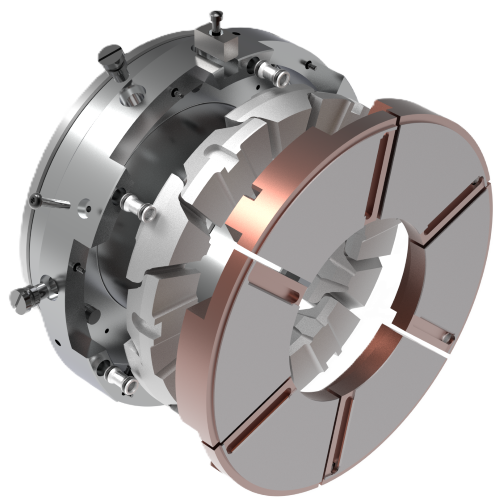
Kingsbury EQH equalizing fluid film thrust bearings are designed to carry high axial loads reliably by distributing that load evenly across multiple pivoted shoes. This equalizing principle, originally developed by Dr. Albert Kingsbury, allows the bearing to maintain stable hydrodynamic films, accommodate minor misalignment, and operate with high load capacity over long service life.
The following overview highlights the primary components of an EQH thrust bearing and explains how each contributes to performance and reliability.
Rotating Thrust Collar
The rotating thrust collar is a forged steel component rigidly attached to the shaft or rotor. It transmits axial thrust load from the rotating equipment to the stationary thrust bearing shoes.
Collar faces are precision ground and lapped flat and smooth. This surface finish reduces frictional losses, promotes uniform oil film formation, and increases load-carrying capability.
Stationary Pivoted Shoes
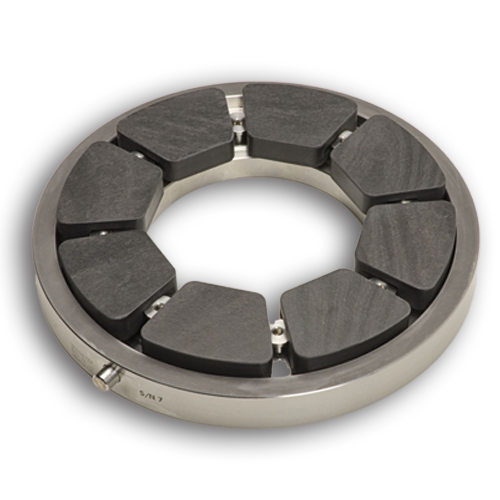
The stationary shoes, also referred to as pads or blocks, form the working surface of the thrust bearing. Each shoe consists of three primary elements.
Shoe Body
Shoe thickness is carefully selected to control thermal and elastic deformation under load. In center-pivoted designs, a controlled amount of elastic or thermal crowning is necessary for effective load carrying, while excessive crowning reduces capacity. Kingsbury optimizes shoe geometry so that deformation contributes to maximum load capacity rather than limiting performance.
Babbitt Face
The babbitt layer thickness is optimized to provide high compressive strength while retaining the desirable embedability characteristic of babbitt materials. This allows small foreign particles in the lubricating oil to embed in the babbitt rather than scoring or damaging the rotating collar, improving durability and tolerance to contamination.
Shoe Support
Each shoe is supported by a spherical pivot that allows it to tilt in both the direction of rotation and the radial direction. This multidirectional movement compensates for minor misalignment between the thrust bearing face and the rotating collar and improves load distribution at all shaft speeds.
The shoe pivot and the upper leveling plate contact surface are manufactured from high-carbon steel and heat treated to approximately Rockwell 50C to prevent wear or damage at the contact interface.
Design Options
While the standard hardened steel support is located at the center of the shoe, it can be offset in the direction of rotation to meet specific application requirements. Special shoe body materials, such as copper alloys, can also be supplied to improve thermal performance. Shoes may be retained if required to facilitate installation.
Stationary Base Ring and Leveling Plate Assembly
The base ring, manufactured from cast, plate, or forged steel, holds the shoes and leveling plates in their operating positions. An oil inlet annulus at the back of the base ring distributes lubricating oil to radial slots that feed the bearing.
This assembly incorporates the equalizing principle developed by Dr. Kingsbury, allowing thrust load to be distributed evenly across all shoes and transmitted uniformly to the bearing housing.
Design Options
Bearing load can be measured by installing strain gauge load cells in the upper leveling plates or thrust shoes. This instrumentation can be retrofitted to existing installations in the field. The base ring may also be drilled and tapped for mounting shim packs or filter plates as required.
Leveling Plates
The leveling plate system allows each shoe to carry an equal share of the total thrust load, preventing localized overload of the babbitted surface or contact areas. In combination with the spherical shoe supports, the leveling plates ensure the thrust bearing face aligns accurately with the rotating thrust collar during operation.
Number of Thrust Shoes
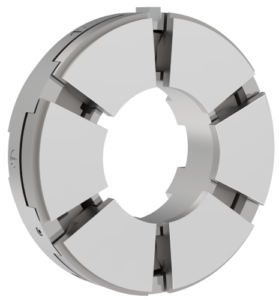
Standard Kingsbury EQH thrust bearings typically use six or eight pivoted shoes, though configurations with up to twenty shoes may be supplied for exceptional applications. Equalized thrust bearings include both upper and lower leveling plates beneath the shoes to ensure proper load sharing.
Design Features and Application Flexibility
EQH thrust bearings are designed for use across a wide range of machines and applications. With center-pivoted shoes, the same bearing design can be used for clockwise, counterclockwise, or bidirectional shaft rotation. These bearings are compatible with most lubricating oils and, due to their equalizing capability, require only reasonable care during assembly to achieve proper alignment.
Kingsbury manufactures many EQH bearing sizes in quantity and maintains inventory at its facilities to support prompt delivery.
Thrust bearings that lack spherical pivots and equalizing leveling plates have a significantly reduced margin of safety. Proper alignment between the bearing, housing, and thrust collar is difficult to achieve consistently, and accumulated manufacturing tolerances limit allowable load. Kingsbury’s EQH design overcomes these limitations by accommodating misalignment and distributing load evenly, providing maximum load capacity throughout the life of the machine.
Applying EQH Thrust Bearing Technology
EQH equalizing thrust bearings are well suited for applications requiring high load capacity, long service life, and tolerance to alignment variation. Their proven design offers reliability across a wide range of operating conditions and machine types.
Kingsbury’s engineering team can assist with bearing selection, design options, and application evaluation to ensure the EQH bearing configuration meets your performance requirements.
Contact Kingsbury to discuss EQH thrust bearing selection, application support, or design considerations.
Industries and Systems Served
Kingsbury LEG thrust bearings operate in environments where efficiency, oil control, and thermal stability are critical. They are installed worldwide in systems such as:
- Gas and steam turbines used in power generation and industrial processes.
- Compressors and pumps supporting oil and gas operations
- Marine propulsion systems across commercial and military fleets
- Industrial gearboxes and turboexpanders
- High-speed test stands and rotating machinery laboratories
Their versatility and documented performance have made LEG bearings a preferred choice for OEMs and retrofit specialists across global rotating equipment markets.
Retrofit or Upgrade Scenarios
LEG bearings are an effective upgrade for older flooded-lubricated systems that are running close to their thermal limits. The directed lubrication and leading-edge groove geometry help reduce oil flow requirements and distribute load more effectively, which allows many retrofits to be completed without major changes to the thrust bearing assembly.
A well-planned LEG retrofit often delivers clear improvements:
• Lower operating temperatures
• Reduced demand on the lube system
• Higher overall efficiency and improved uptime
Kingsbury’s engineering and field service teams support every retrofit with proper fit checks, alignment guidance, and commissioning support to ensure the bearing performs as intended over the long term.
Retrofit or Upgrade Scenarios
LEG bearings are an effective upgrade for older flooded-lubricated systems that are running close to their thermal limits. The directed lubrication and leading-edge groove geometry help reduce oil flow requirements and distribute load more effectively, which allows many retrofits to be completed without major changes to the thrust bearing assembly.
A well-planned LEG retrofit often delivers clear improvements:
• Lower operating temperatures
• Reduced demand on the lube system
• Higher overall efficiency and improved uptime
Kingsbury’s engineering and field service teams support every retrofit with proper fit checks, alignment guidance, and commissioning support to ensure the bearing performs as intended over the long term.