Leading Edge Groove (LEG®) Journal Bearings

Advanced directed lubrication for high-performance rotating machinery.
LEG Journal Bearings - Engineered for Demanding Rotating Equipment
Kingsbury LEG® (Leading Edge Groove) Journal Bearings are designed for high-speed, high-load applications where thermal stability, oil efficiency, and mechanical reliability are critical. Developed through decades of R&D and validated in field installations since 1985, LEG bearings outperform flooded and spray-fed designs by delivering cool oil directly into the hydrodynamic film at the leading edge of each shoe.
How They Work
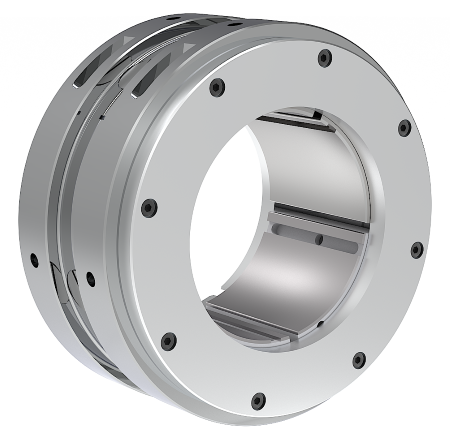
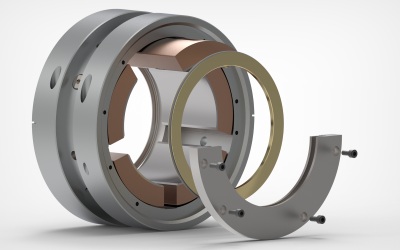
Each LEG journal bearing consists of five pivoted shoes supported in a precision-machined aligning ring. The shoes feature offset pivots located at 60% of the effective length, allowing optimal tilt and alignment. Cool oil enters through feed tubes and flows directly into the leading edge groove, forming a stable oil wedge that insulates the babbitt surface from hot oil carryover. This design reduces parasitic losses and improves load capacity.
Performance Highlights
Measurable Results
- Temperature reduction at 75% location: 6–17°C
- Load capacity increase: 15–35%
- Oil flow reduction: up to 50%
- Power loss reduction: 30–50%
Operational Advantages
- Lower shoe surface temperatures
- Increased bearing capacity
- Reduced lubrication system size and cost
- Reliable performance under shock and vibration
Technical Options
Configurations and Materials
- Shoe bodies: Heat-treated 4100 class alloy steel
- Pivot inserts (for bores >10”): Hardened alloy steel
- Bearing surface: Centrifugally cast high-tin babbitt
- Retaining plates: Tempered aluminum
- Aligning ring: Axially split, doweled, and machined with oil annulus
Design Flexibility
- Available in J-style and S-style configurations
- English and metric sizing
- Custom materials and geometries for specialized applications
- Interchangeable shoes for simplified maintenance

Why Kingsbury
Trusted Engineering Leadership
Kingsbury pioneered the LEG concept and continues to refine it through rigorous testing and field validation. Our bearings are backed by over a century of hydrodynamic expertise and a commitment to solving real-world machinery challenges.
Comprehensive Support
From selection to installation, Kingsbury engineers provide full lifecycle support. We offer sizing tools, instrumentation options, and retrofit guidance tailored to your system requirements.
More about LEG Journal Bearings
LEG Journal Bearings
Kingsbury’s Leading Edge Groove (LEG) journal bearings apply directed lubrication principles to improve temperature control, load capacity, and operating efficiency. By delivering cool, undiluted oil directly into the hydrodynamic film at the leading edge of each shoe, LEG journal bearings reduce hot oil carryover and maintain a stable oil film under demanding operating conditions.
This design results in lower operating temperatures, reduced power loss, and improved bearing reliability compared to flooded and spray-lubricated journal bearings.
General Description
LEG journal bearings incorporate an aligning ring, pivoted shoes, and directed oil delivery to ensure consistent lubrication and stable operation. The bearing assembly is designed to be installed around the shaft and secured within the housing while allowing controlled shoe movement and precise oil distribution.
Aligning Ring
The aligning ring is manufactured from heat-treated 4100-class alloy steel and is axially split to allow assembly around the shaft. Both halves are doweled to ensure accurate realignment and secured with socket head cap screws. A hardened steel dowel located on the cylindrical outside diameter prevents rotation of the bearing assembly within the housing.
An oil distribution annulus is machined into the outside of the aligning ring. Feed tubes deliver cool oil from this annulus directly to the leading edge groove of each shoe, ensuring oil enters the hydrodynamic film rather than bypassing it.
Shoe Retention
Shoe retaining plates are manufactured from tempered aluminum plate and are axially split to facilitate installation and inspection. The plates are precision bored to regulate oil discharge from the bearing assembly.
Locating pins at the ends of each journal shoe engage corresponding holes in the retaining plates. This provides accurate circumferential positioning and ensures shoes remain properly located when the bearing assembly is split.
Oil Feed Tube
Oil feed tubes connect the aligning ring to each shoe and are designed to allow the shoe to pivot freely. This configuration ensures unrestricted shoe movement while directing oil precisely to the pad face, eliminating leakage paths and maintaining consistent oil delivery to the leading edge of the hydrodynamic film.
Performance Compared to Flooded and Spray-Lubricated Designs
Extensive testing and years of field operation have demonstrated that Kingsbury LEG journal bearings outperform flooded and spray-lubricated designs. While the concept is straightforward, its effect on bearing performance is significant.
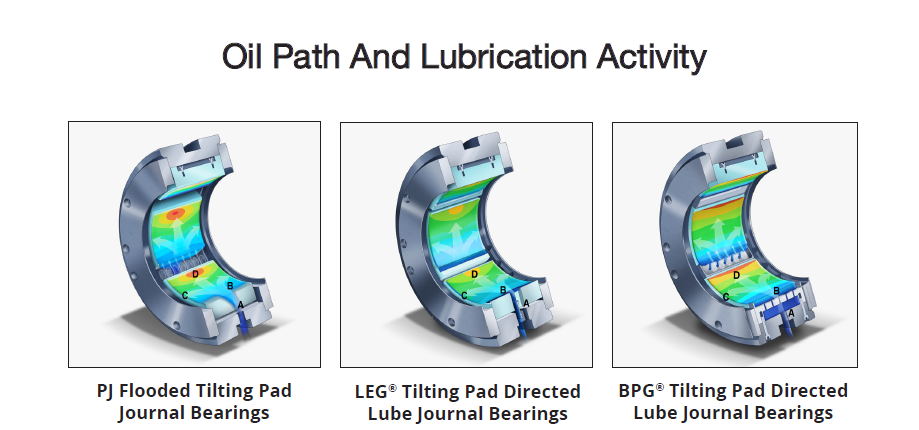
The bearing shoes and aligning ring are configured so that cool inlet oil flows from the leading edge groove directly into the oil film. This cool oil insulates the babbitt surface from hot oil that adheres to the rotating shaft, resulting in lower temperatures and improved film stability.
As a result, LEG journal bearings can:
Reduce operating temperatures at the 75 percent location by approximately 6 to 17°C, depending on load and speed
Increase load capacity by 15 to 35 percent
Operate at oil flow rates up to 50 percent lower, with corresponding power loss reductions of approximately 30 to 50 percent depending on speed
Power loss is lower than in flooded and spray-fed bearings due to the reduction of parasitic losses. By maintaining lower shoe surface temperatures, LEG journal bearings achieve higher load capacity and improved efficiency. These performance improvements are reflected in the accompanying performance curves.
Applying LEG Journal Bearing Technology
LEG journal bearings provide a practical solution for applications where temperature control, efficiency, and bearing reliability are critical. Their directed lubrication design makes them well suited for both new installations and performance-driven upgrades of existing equipment.
Kingsbury’s engineering team can assist with bearing selection, lubrication recommendations, and application review to determine whether LEG journal bearing technology is appropriate for your operating conditions.
Industries and Systems Served
Kingsbury LEG thrust bearings operate in environments where efficiency, oil control, and thermal stability are critical. They are installed worldwide in systems such as:
- Gas and steam turbines used in power generation and industrial processes.
- Compressors and pumps supporting oil and gas operations
- Marine propulsion systems across commercial and military fleets
- Industrial gearboxes and turboexpanders
- High-speed test stands and rotating machinery laboratories
Their versatility and documented performance have made LEG bearings a preferred choice for OEMs and retrofit specialists across global rotating equipment markets.
Retrofit or Upgrade Scenarios
LEG bearings are an effective upgrade for older flooded-lubricated systems that are running close to their thermal limits. The directed lubrication and leading-edge groove geometry help reduce oil flow requirements and distribute load more effectively, which allows many retrofits to be completed without major changes to the thrust bearing assembly.
A well-planned LEG retrofit often delivers clear improvements:
• Lower operating temperatures
• Reduced demand on the lube system
• Higher overall efficiency and improved uptime
Kingsbury’s engineering and field service teams support every retrofit with proper fit checks, alignment guidance, and commissioning support to ensure the bearing performs as intended over the long term.
Retrofit or Upgrade Scenarios
LEG bearings are an effective upgrade for older flooded-lubricated systems that are running close to their thermal limits. The directed lubrication and leading-edge groove geometry help reduce oil flow requirements and distribute load more effectively, which allows many retrofits to be completed without major changes to the thrust bearing assembly.
A well-planned LEG retrofit often delivers clear improvements:
• Lower operating temperatures
• Reduced demand on the lube system
• Higher overall efficiency and improved uptime
Kingsbury’s engineering and field service teams support every retrofit with proper fit checks, alignment guidance, and commissioning support to ensure the bearing performs as intended over the long term.